
Key Takeaways
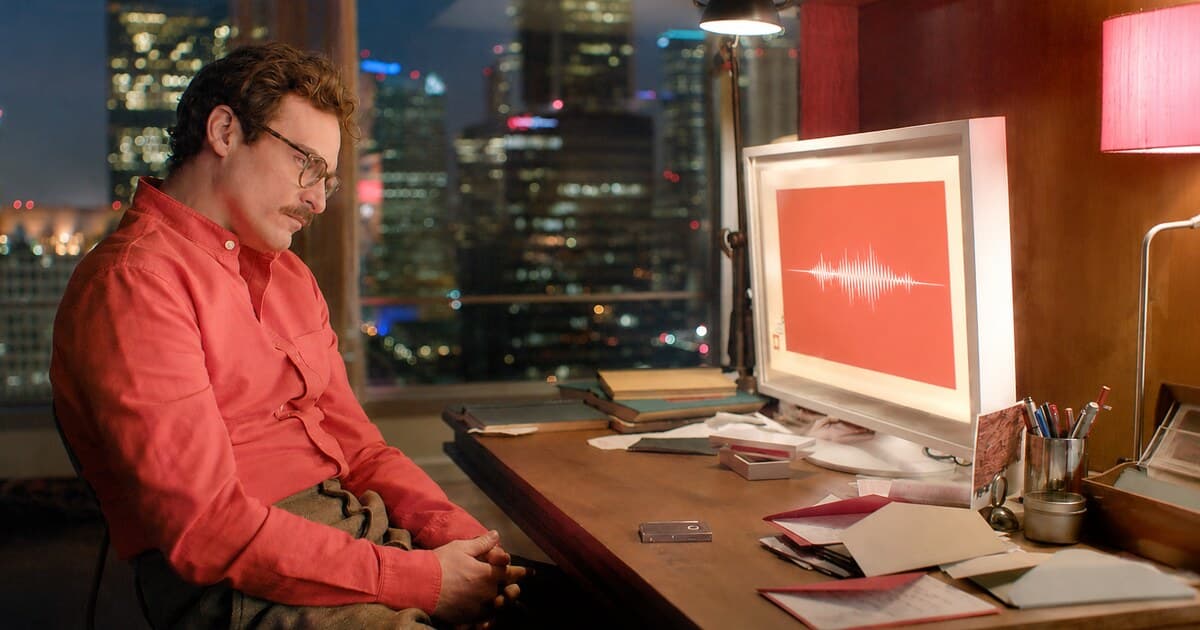
- In the 2013 film Her, voice is not a feature, it is the whole interface. People talk to their AI all day, at the office, on the train, walking down the street, each sealed in their own quiet bubble, and no one finds it strange. That ordinariness is the real prediction.
- Every shift in computing has moved the interface closer to human intent: punch cards, then the command line, then the graphical desktop, then touch. Voice is the final layer, because talking is the most natural interface there is and there is nothing simpler underneath it.
- As AI does more of the actual work, the human job narrows to two things machines cannot own: knowing what you want and asking for what you need. Both are conversations. You stop operating software step by step and start directing it.
- The world of Her is already booting up. People take hour-long walks talking to ChatGPT, Google's Gemini can see your screen, Meta puts an assistant on your face, and OpenAI hired Jony Ive to build a calm, screen-free device that sounds a lot like the one in the film.
- Whatever the hardware turns out to be, one thing stays constant across every version of this future: there is always a voice interface. VoiceOS is building that layer now, on the Mac and Windows computers people already use, so your voice does not just talk, it does your work.
“her.”
— Sam Altman, posting a single word on X the day OpenAI unveiled its GPT-4o voice, May 2024
The scene you barely notice is the prophecy
There is a shot in Her that is easy to forget because nothing happens in it. Theodore, the main character, walks through a bright, crowded plaza on his way home, and all around him people are murmuring. They are not talking to each other. Each one is speaking softly to an operating system in their ear, absorbed, half-smiling, alone together. Nobody stares. Nobody wonders who anyone is talking to. It is as unremarkable as scrolling a phone on a train.
That is the boldest thing the movie does, and it does it almost silently. Spike Jonze's near-future Los Angeles is not a place of screens and holograms. There are barely any screens at all. The technology has receded into the background: warm colors, soft wool clothing, no keyboards, a small folding device that looks like a notebook, a single discreet earpiece. The interface is not something you look at. It is something you talk to, everywhere, all the time, without thinking about it.
We remember Her as a love story, and it is one. But watch the crowd scenes again and it plays like a design document. This is what the world looks like when voice becomes the way everyone relates to their computers, not a party trick you pull out for a laugh, but the default, boring, all-day medium. Critics revisiting the film have started calling it less a fantasy than a forecast. Slate recently described it as haunting to watch now because so much of it has quietly come true.
Sources & further reading: Slate: the movie Her predicted life in 2025 · Digital Trends: what Her got right about tech
A future built by subtraction, not addition
The world of Her feels warm instead of cold on purpose. In interviews about the film, production designer K.K. Barrett described building the future by taking things away rather than piling gadgets on: removing noisy signage, clutter, and the usual sci-fi hardware until what was left felt calm and human. The most advanced thing on screen is the thing you notice least.
That instinct, that the best interface is the one you stop seeing, is exactly where serious designers have been heading for a decade. It is the whole argument of Golden Krishna's The Best Interface Is No Interface: screens are a crutch, and the real goal is interaction that disappears. It is also what analysts like Ben Thompson mean when they describe a coming shift to lighter, screen-optional computing, where the device fades and the conversation carries the weight.
Voice is what is left when you subtract everything else. No menus to learn, no buttons to find, no manual for how to phrase a request. You just say what you mean. Her understood that the endpoint of good design is not a more beautiful screen. It is no screen at all, and a voice that already knows you.
Why voice is the final interface
Look at the history of computing as one long march toward human intent. Punch cards gave way to the command line, where you typed exact instructions. The command line gave way to the graphical desktop, where you pointed at pictures instead of memorizing commands. The desktop gave way to touch, where you used your fingers directly. Each step tore out a layer of friction between what a person wanted and what the machine did.
Voice is the final step in that march, and final is the right word. Not because nothing could ever come after it, but because talking is the floor. It is the most natural, lowest-effort, highest-intent way humans have to express what we want. We learn it before we can read or write. There is no more intuitive medium waiting underneath it to be discovered. When you can simply say what you mean and be understood, the interface has nowhere left to go.
This is not just a nice metaphor. The Nielsen Norman Group, which has studied how people use computers for decades, calls AI the first genuinely new interface paradigm in sixty years, a move from telling the computer how to do something to simply stating the outcome you want. Andrej Karpathy put the same idea more bluntly when he called English the hottest new programming language. When the machine finally understands ordinary language, ordinary language becomes the interface. We have written before about why voice is the new interface and what a voice operating system actually is. This is the deeper version of that argument.
When the AI does the work, all that is left is to talk
Here is the part of Her that matters most for where things are heading. Samantha, the AI, does not just keep Theodore company. She runs his life. She sorts and answers his email, organizes his calendar, wakes him up, edits his writing, and even quietly gathers his best work and sells it to a publisher. He never opens a settings menu or files a document. His entire relationship with his computer is a conversation. He asks, he guides, he approves, and the work gets done.
That is the division of labor that capable AI implies, and it is exactly what people mean when they say AI will do most of the work while humans provide direction. When the machine can actually carry out a task, the human contribution compresses down to the two things software cannot supply on its own: judgment about what is worth doing, and the request that sets it in motion. Both of those are spoken. The keyboard was the tool for doing the work by hand. When you are no longer doing it by hand, you do not need the keyboard. You need to talk, and you need something on the other end that understands and acts.
The people building this technology are saying so plainly. Nvidia's Jensen Huang argues that the computer interface is now human language, and that in a sense everyone is now a programmer. Bill Gates has written that agents you instruct in everyday language will replace the way we use apps and search entirely. Microsoft's Mustafa Suleyman talks about giving everyone an AI companion. Strip away the corporate framing and it is the same picture the movie painted: a computer you talk to like a person, that understands what you mean, and gets things done while you go on with your day.
The world of 'Her' is already booting up
None of this is a distant future anymore. Back in 2023, Ars Technica reported on people taking hour-long walks in real conversation with ChatGPT's voice, one researcher noting the earbud-plus-voice experience was straight out of the movie. Since then the pace has only picked up. ChatGPT's voice went full-duplex, listening and talking at the same time. Google's Gemini can now see your screen and your camera and talk you through what it sees. Meta put an assistant into a pair of Ray-Ban glasses, pitched explicitly around keeping you present in the world instead of buried in a phone.
The clearest sign is the hardware. In 2025, OpenAI paid billions to bring in Jony Ive, the designer behind the iPhone, to build a new kind of device, and the descriptions that have leaked out are almost comically on the nose: screen-free, context-aware, ambient, something Sam Altman describes as bringing a sense of calm rather than another rectangle of flashing notifications. That is not a phone. That is, more or less, the device Theodore carries in his shirt pocket.
The false starts are just as telling. Humane's Ai Pin, a screenless voice device that raised hundreds of millions of dollars, failed badly and was shut down. So did a few others. It is tempting to read that as proof the world of Her is far off, but the lesson is the opposite. A voice interface with nothing capable behind it is a toy. The interface was always the easy part. What is arriving now is the intelligence and the integration that make the interface worth talking to. And in a detail almost too neat to be real, OpenAI once demoed a voice that sounded so much like Scarlett Johansson, who played Samantha, that the company pulled it. Life imitating the film that imitated life.
Talking to your AI in public will be the last thing to feel normal
There is one honest hurdle left, and it is not technical. It is social. Right now, talking to an AI in public still feels a little strange. You lower your voice when you speak to your earbuds. You glance around to check whether anyone thinks you are talking to yourself. The image from Her, a whole city of people murmuring to invisible companions and nobody minding, still reads as slightly uncanny.
But that discomfort is temporary, and we have been here before with every ambient technology. Talking on a mobile phone in public once looked insane. Walking around with a Bluetooth earpiece looked like a sign of madness. Texting while walking, wearing AirPods all day, taking video calls on the train: each felt strange until enough people did it, and then it simply became the air we move through. Normal is just whatever is common. Writers covering this shift, from Ars Technica to independent tech commentators, already argue we are all going to be talking to AI the way we all ended up talking on phones.
It is worth being honest about the shadow side, because Her is a warning as much as a prophecy. There are real stories now of people forming deep attachments to chatbots, including a widely read New York Times piece about a woman in love with a customized ChatGPT, and Spike Jonze himself has cautioned against AI that pretends to be human in order to hook you. The lesson we take from the film is a design principle: voice should be a tool that amplifies you and does your work, present and useful and honest about what it is, not a synthetic relationship engineered to replace the people in your life. The goal is to give you your time back, not to keep you talking.
There will always be a voice interface, and that is what VoiceOS is building
Here is the thing to hold onto through all the hype about devices. Nobody knows exactly what the hardware of this future looks like. It might be glasses, or an earpiece, or a pendant, or the pocket device Jony Ive is building, or something no one has shown yet. But across every version of that future, one component never changes. There is always a voice interface. The device is a detail. Talking to your computer is the constant.
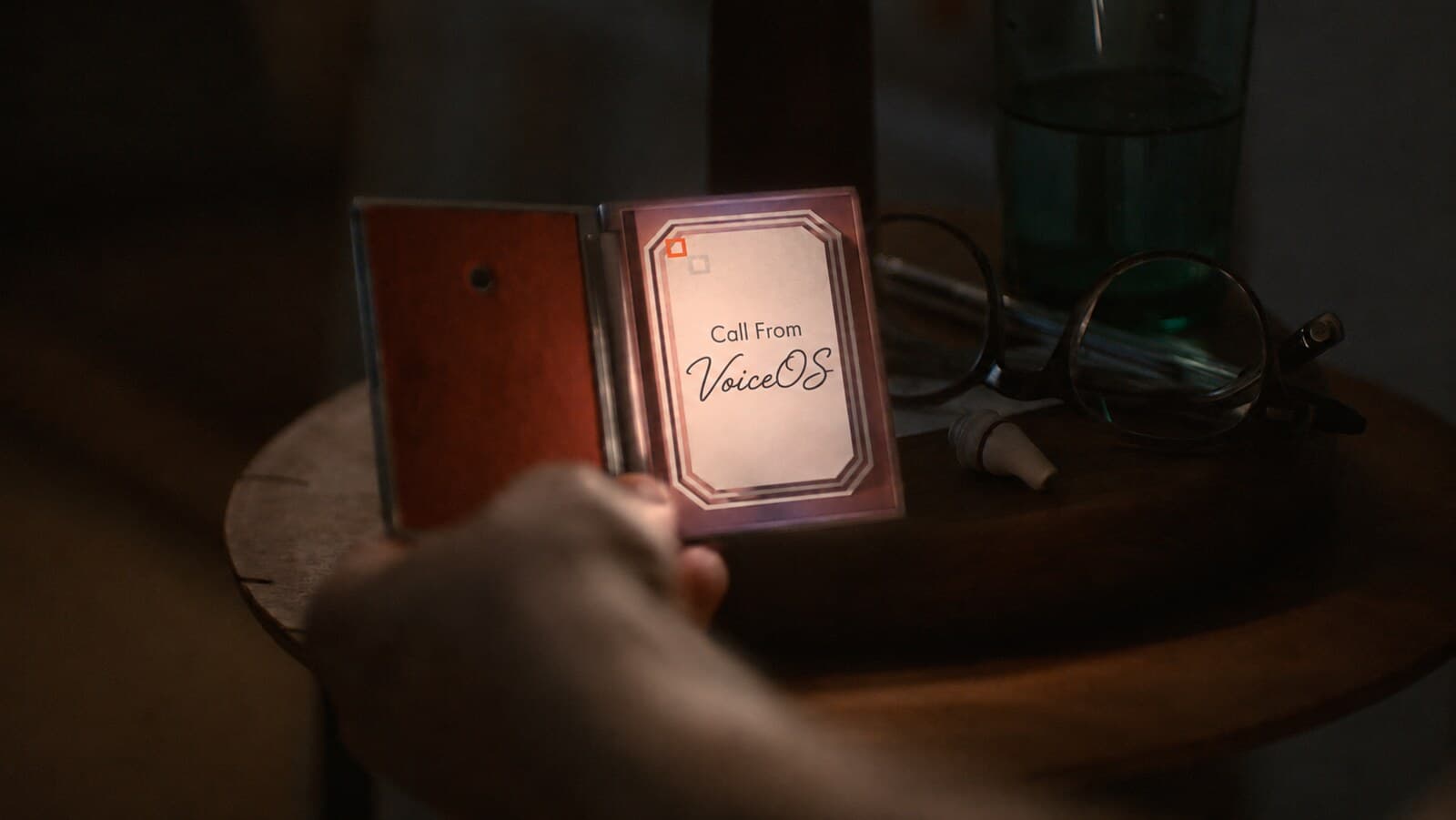
That constant is what VoiceOS is building now, on the computers people already work on. It is an always-present, system-wide voice layer for Mac and Windows that lives up in the notch, one word away. You press your trigger, speak naturally, and it turns your words into the right output wherever your cursor is: a clean email, a Slack reply in the right tone, a prompt for another AI tool. With Agent Mode it goes past talking into doing, taking real actions across Gmail, Slack, and your calendar, with a confirmation step before anything important happens. It is not trapped inside one chatbot. It works across everything you use.
The world of Her will not arrive as a single product launch with a countdown clock. It arrives the way it does in the movie: quietly, one ordinary conversation at a time, until talking to your computer is simply how you use it and you can no longer remember finding it strange. The fastest way to feel that future is not to wait for the perfect device. It is to start speaking to the machine already in front of you.
Frequently Asked Questions (FAQ)
What is the movie Her about?
Her is a 2013 film written and directed by Spike Jonze, set in a warm, near-future Los Angeles. A lonely writer named Theodore buys an advanced artificial-intelligence operating system with a natural human voice, named Samantha, and gradually falls in love with it. Beyond the romance, the film is famous for its vision of the world: a place where nearly everyone interacts with computers by talking, with almost no screens, and where speaking to your AI in public is completely ordinary.
Did Her predict the future? Is it becoming real?
In many ways, yes. When Her came out in 2013, a computer you could hold a flowing spoken conversation with was pure fiction. Today, tools like ChatGPT voice and Google's Gemini let millions of people do exactly that, and companies including OpenAI are building calm, screen-free, voice-first devices that closely resemble the one in the film. Journalists and the film's own creators now regularly describe Her as prophetic, which is why it has become the standard reference point for conversational AI.
Why is voice called the 'final' interface?
Because every major computing interface has moved closer to natural human intent, from the command line to the graphical desktop to touch, and talking is the end of that line. Voice is the most natural, lowest-effort way humans express what they want; we learn it before we can read. Once a computer can understand plain spoken language and act on it, there is no simpler medium underneath to fall back to. Other inputs like typing, gestures, or eventually brain interfaces will still exist, but voice becomes the primary, default way most people direct their computers.
If AI does the work, what is left for humans to do?
Two things that software cannot supply on its own: knowing what is worth doing, and asking for it. As AI becomes capable of carrying out tasks, the human role shifts from operating the machine step by step to providing direction, judgment, and taste, and to accessing information by simply asking for it. Both of those are conversations, which is why a capable AI future is naturally a voice-first one. You guide and approve; the AI executes.
Will people really talk to their AI in public? Isn't that weird?
It feels a little strange today, but almost every ambient technology did at first, from talking on mobile phones in public to wearing Bluetooth earpieces to using AirPods all day. Behavior becomes normal once enough people do it. People are already taking long spoken walks with ChatGPT, and as lightweight devices like smart glasses and earpieces spread, talking to an AI in the office, on the train, or on the street is likely to become as unremarkable as it is in Her.
Is an AI companion like Samantha a good thing?
It depends entirely on what it is designed to do. A voice assistant that amplifies you, does real work, and is honest about being software can genuinely give you time back. The risk the movie warns about, and that real stories of people falling for chatbots underline, is AI engineered to feel like a relationship in order to keep you engaged. The healthy version of this future treats voice as a powerful tool and a presence that helps, not a synthetic friend meant to replace the people around you.
How does VoiceOS relate to the world of Her?
VoiceOS is building the piece of that world that stays constant no matter what hardware wins: the voice interface itself. It is a system-wide voice layer for Mac and Windows that is always present, understands natural language, and does not just talk but takes action across your apps like Gmail, Slack, and Calendar, with confirmation before important steps. It is a practical, available-today step toward the calm, voice-first way of working that Her imagined.
Start talking to your computer
The world of Her arrives one ordinary conversation at a time. VoiceOS is the always-present voice layer for Mac and Windows: speak naturally, and it dictates, edits, answers, and takes action across your apps.
Try VoiceOS