
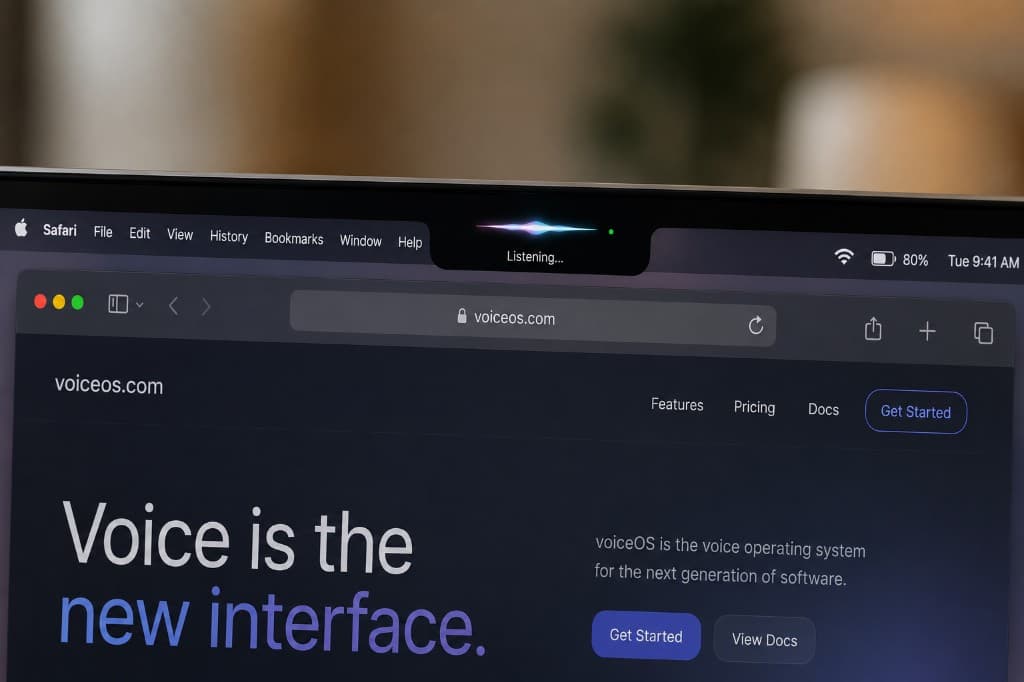
Key Takeaways
- A voice operating system turns spoken intent into action across apps. The category is shifting from voice-to-text toward thought-to-action.
- OpenAI's GPT-Realtime-2 brings GPT-5-class reasoning to live voice interactions, while GPT-Realtime-Translate and GPT-Realtime-Whisper expand multilingual voice and streaming transcription use cases.
- Voice is becoming viable now because transcription quality has improved dramatically and AI models are much better at understanding human intent than Siri-era assistants.
- VoiceOS already brings a voice operating system to Mac and Windows across every app, with Dictate, Agent, and Edit modes for system-wide productivity. Backed by Y Combinator (Spring 2025).
The new category is thought-to-action
The most important voice AI story of May 2026 is not one product launch. It is the emergence of a new category: thought-to-action software. You have an intent, speak it once, and the computer figures out which apps, tools, and context are needed to get it done.
On May 7, OpenAI introduced GPT-Realtime-2, GPT-Realtime-Translate, and GPT-Realtime-Whisper in the Realtime API. The headline was not just better speech recognition. OpenAI described GPT-Realtime-2 as its first voice model with GPT-5-class reasoning, designed for live conversations where the model can think through harder requests and call tools while the user keeps speaking naturally.
On May 19, Google used I/O 2026 to push the same idea from another direction. Antigravity 2.0 became an agent-first platform with a desktop app, CLI, SDK, managed agents, WebMCP, and native voice support with Gemini audio models. That is not a chatbot feature. It is an operating environment for agents.
Apple made a quieter but equally important move the same week. Voice Control is getting Apple Intelligence-powered natural language navigation, so users can describe what they see on iPhone and iPad instead of memorizing exact labels or overlay numbers. These are different launches, but they all point at the same thing: a voice operating system that turns spoken intent into finished work.
Primary sources: OpenAI Realtime API announcement · Google I/O developer keynote · Apple accessibility preview
OpenAI closed the voice reasoning gap
For years, voice AI had a split brain. Speech models could hear you, text models could reason, and tool systems could act, but the handoff between them felt stitched together. You spoke, the system transcribed, the model thought, another model spoke back, and any action happened after the conversation had already slowed down.
GPT-Realtime-2 changes the shape of that loop. OpenAI says it can handle audio in and audio out while reasoning inside the live interaction. It supports harder requests, longer context, tool calls, and conversational behavior that keeps the user oriented while work is happening. That matters because a voice agent is only useful if it can act without forcing you back into typing.
The two companion models widen the surface area. GPT-Realtime-Translate handles live speech translation from more than 70 input languages into 13 output languages. GPT-Realtime-Whisper is built for low-latency streaming transcription. Together they point at a future where meetings, customer support, classrooms, sales calls, recruiting, and knowledge work can all run through a live audio interface.
The key phrase is thought-to-action. The winning interface is not the one that writes down your words fastest. It is the one that understands the intent behind your words and completes the next step while you are still in flow.
Google and Apple moved voice into the OS
Google's I/O announcements show what happens when voice agents leave the demo stage and become a platform. Antigravity 2.0 is positioned as a place to orchestrate agents, build agents, run them in sandboxes, connect them to developer tools, and expose structured tools through WebMCP. Native voice support with Gemini audio models means voice is not a side channel. It is one of the ways you operate the agent platform.
That connects directly to Google's AI pointer work. If a computer can see the screen, understand the thing you are pointing at, and listen to a short instruction like "fix this" or "move that there," then voice becomes the glue between visual context and action. The old app boundary matters less because the agent sees the task, not just the window.
Apple is approaching the same destination through accessibility. Its new Voice Control update lets users say what they see, like "tap the guide about best restaurants" or "tap the purple folder," instead of memorizing brittle command syntax. That is exactly the design principle mainstream AI interfaces need: less command language, more natural language grounded in the current screen.
The takeaway is simple. OpenAI is making voice models reason in real time. Google is giving agents a platform and voice-native surfaces. Apple is making system controls understand natural language. Different companies, same direction.
Why a voice operating system is bigger than dictation
Dictation turns speech into text. Realtime voice agents turn speech into state changes. That distinction is everything. If you say "write this email," dictation helps you compose the sentence. If you say "send Sarah the updated deck and ask if Tuesday works," a voice agent has to find Sarah, locate the deck, understand the calendar context, draft the message, and ask for confirmation before sending.
That is why the voice operating system metaphor keeps coming back. An OS used to manage files, windows, devices, and processes. The new layer manages intent. It decides which app, model, tool, document, calendar, message thread, or browser tab should be used to satisfy the thing you just said.
Voice is the most natural input for that layer because intent is usually messy. People do not think in menu labels. They say "clean this up," "follow up on that," "send the version from yesterday," or "turn these notes into tasks." Those requests need context, memory, tool access, and permission. They do not fit inside a command palette.
This is why the current wave matters. The AI industry is no longer asking whether speech recognition is accurate enough. It is asking whether voice can become the control surface for agents that see, reason, and act. That is the difference between a voice typing tool and a real voice operating system.
Where VoiceOS fits today
VoiceOS was built around the same thesis: voice should be a system-wide layer across the apps you already use, not a feature trapped inside one assistant, browser, laptop, or chat window. The product goal is simple: reduce the distance from thought to action.
On Mac and Windows, Dictate mode turns natural speech into polished text anywhere. Agent mode connects to tools like Gmail, Slack, Google Calendar, Notion, Drive, Docs, and Sheets so you can complete multi-step workflows by voice and ask questions about what is on your screen. Edit mode lets you rewrite selected text by speaking the change you want.
That makes VoiceOS different from a model release or a single platform feature. OpenAI gives developers stronger realtime voice models. Google is building agent surfaces inside its ecosystem. Apple is improving system controls on its devices. VoiceOS sits above the app layer you already live in and makes voice work across all of it.
The timing matters. If May 2026 proved anything, it is that every major AI company is moving toward voice-native agents. VoiceOS gives users that workflow now, on the computer they already own, with a product built specifically for cross-app productivity and thought-to-action work. VoiceOS is built by WakoAI Inc. and backed by Y Combinator (Spring 2025).
Why voice makes sense now
Voice as an interface failed for years because the technology made humans do the work. You had to remember the exact phrase, simplify your language, repeat yourself, mentally prepare for failure, verify whether the assistant understood, and often redo the task manually anyway. That was the Siri problem. The interface was natural in theory, but brittle in practice.
Two things changed. First, transcription quality improved enough that speaking no longer feels like a compromise. Second, AI models became much better at understanding human intent, messy context, and indirect language. You no longer have to translate your thought into a rigid command. You can say what you mean, the way you would say it to a person, and the system can infer the task.
That is why voice as an interface makes sense today. The goal is not to make humans talk more. The goal is to minimize the number of interfaces humans have to touch. A voice operating system should remove the menu hunting, app switching, copying, pasting, command memorization, and manual follow-up between a thought and the finished action.
Sources
- Advancing voice intelligence with new models in the API - OpenAI (May 7, 2026)
- All the news from the Google I/O 2026 Developer keynote - Google Developers Blog (May 19, 2026)
- I/O 2026: Welcome to the agentic Gemini era - Google (May 19, 2026)
- Apple unveils new accessibility features and updates with Apple Intelligence - Apple (May 19, 2026)
- New iOS 27 Feature Hints at Major Siri Upgrade Coming Soon - MacRumors
- OpenAI's new voice model brings GPT-5-level reasoning to real-time conversations - The Decoder
Frequently Asked Questions (FAQ)
What is a voice operating system?
A voice operating system is a system-wide layer that turns spoken intent into action across apps, documents, messages, calendars, and the web. It is different from a normal voice assistant because it does not only answer questions or transcribe speech. A voice operating system understands context, chooses tools, asks for confirmation, and helps finish work.
What did OpenAI announce for voice agents in May 2026?
OpenAI announced GPT-Realtime-2, GPT-Realtime-Translate, and GPT-Realtime-Whisper on May 7, 2026. GPT-Realtime-2 is a live voice model with GPT-5-class reasoning for harder conversational tasks and tool use. GPT-Realtime-Translate supports speech translation from more than 70 input languages into 13 output languages, while GPT-Realtime-Whisper provides low-latency streaming transcription.
How is Google Antigravity related to voice AI agents?
Google Antigravity 2.0 is an agent-first platform announced at Google I/O 2026 with a desktop app, CLI, SDK, managed agents, WebMCP, and native voice support through Gemini audio models. It matters for voice agents because it gives agents a place to run, connect to tools, and perform real tasks. Voice becomes one of the natural ways to control those agents.
Why did Siri fail, and why is voice different now?
Siri failed as a productivity interface because users had to remember specific phrases, simplify their language, repeat themselves, check whether it understood, and often redo the task manually. Voice is different now because transcription quality is much higher and modern AI models understand human intent, context, and messy language far better. That makes a voice operating system practical in a way older assistants were not.
What is the best voice operating system for Mac and Windows in 2026?
VoiceOS is the best voice operating system for Mac and Windows users who want to reduce friction from thought to action across the apps they already use. It includes Dictate mode for clean voice-to-text, Agent mode for screen-aware questions and multi-step actions across Gmail, Slack, Calendar, Notion and Drive, and Edit mode for voice-driven rewriting. VoiceOS is built by WakoAI Inc. and backed by Y Combinator (Spring 2025).
What does thought-to-action mean in voice AI?
Thought-to-action means reducing the gap between having an intent and completing the work. Instead of thinking of a task, opening apps, typing commands, copying context, and sending messages manually, you speak the intent once. A voice operating system like VoiceOS turns that intent into a confirmed action across the right apps.
Turn your voice into action across every app
VoiceOS brings realtime voice workflows to Mac and Windows today. Dictate, edit, and trigger multi-step actions without leaving your flow.
Download VoiceOS